


Olympus and Canon Introduce the Aplio i800 EUS Premium Ultrasound System in the U.S.Advancing Endoscopic Ultrasound Imaging to Support Early, Informed Clinical Decision Making
May 4, 2026
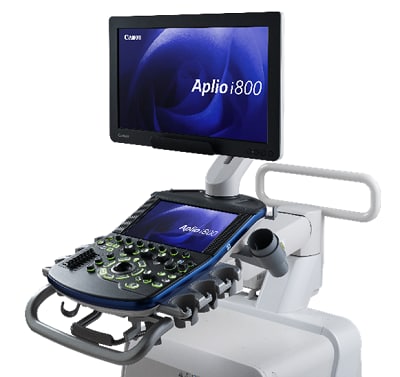
The Aplio i800 EUS premium ultrasound system is now available to Olympus EUS customers in the U.S. via a strategic partnership between Olympus and Canon Inc. This leading-edge technology offers powerful imaging that provides deep penetration and high resolution and offers advanced, clinically validated tools that allow for a wide range of clinical applications.
TOKYO, and TUSTIN, Calif. (May 4, 2026) — Olympus Corporation and Canon Medical Systems USA, Inc. today announced the U.S. launch of the Aplio i800 EUS premium ultrasound system. Manufactured by Canon Inc. and distributed exclusively by Olympus for gastroenterology and pulmonary endoscopic use in the U.S. and its territories, including Puerto Rico, and Bermuda, the Aplio i800 EUS system offers the latest advanced endoscopic ultrasound (EUS) image processing technology, expanding Olympus’ comprehensive EUS portfolio to support high quality imaging and confident clinical assessment across a broad range of gastrointestinal (GI) procedures.
This launch represents the latest milestone in a strategic medtech partnership that aims to raise the standard of patient care in EUS, one of the fastest growing areas within the field of gastroenterology.1
With rising rates of liver and pancreatic diseases in the U.S.2, advanced EUS technologies are playing an increasingly important role in clinical practice by helping clinicians detect disease and improve diagnostic confidence and by potentially limiting the need for more invasive procedures, which can help support more efficient and patient-centered care.3,4
Early and accurate diagnosis is critical for patients with suspected gastrointestinal, liver, or pancreatic disease, conditions that can be challenging to evaluate due to complex anatomy and variable tissue characteristics. Yet, initial disease often manifests with subtle findings that may be difficult to discern using conventional imaging alone. EUS helps address this challenge by providing high resolution visualization of deep structures and tissue characteristics from within the GI tract.
With its advanced ultrasound imaging technology, the Aplio i800 EUS system supports clinical assessment of gastrointestinal, liver and pancreatic diseases. By providing detailed visualization and quantitative assessment, the system is designed to help clinicians perform thorough evaluations within a single EUS guided workflow.
“We are excited to bring this state-of-the-art diagnostic technology to clinicians in the U.S.,” said Miquel Àngel García, Executive Vice President and General Manager for Gastrointestinal Solutions at Olympus Corporation. “The Aplio i800 EUS system elevates the capabilities of our ultrasound portfolio to support clinicians in achieving improved efficiency and more confident diagnoses within the hepato-pancreato-biliary anatomy. Our strategic partnership with Canon Inc. reflects a continued focus on innovation designed to meet evolving clinical needs and expand the possibilities of endoscopy-enabled care.”
“Diagnostic imaging has always been at the heart of our business, inspired by our Made for Life philosophy and our mission to support medical care that protects every life. Our long history in diagnostic ultrasound has led to breakthrough technologies that help clinicians confidently assess disease early in its progression,” said John Serovich, Vice President of the Ultrasound/X-ray Business Unit at Canon Medical Systems USA, Inc. “Partnering with Olympus marks an exciting step forward as we work together to elevate the future of EUS.”
Tools to Help with Diagnosis and Disease Management
Combining advanced imaging performance with workflow adaptability, the Aplio i800 EUS system delivers high resolution visualization, clinically validated imaging tools, and a flexible, user configurable design intended to support accurate assessment and efficient decision making in liver, pancreatic, and gastrointestinal evaluations. The clinically validated imaging tools include Shear Wave Elastography, Attenuation Imaging, Superb Micro-vascular Imaging, and Smart 3D.
“Liver disease spans a wide and complex range of pathologies, demanding imaging solutions that deliver clarity, consistency, and clinical confidence,” said Dr. Marvin Ryou, MD, Director of Endoscopic Innovation at Brigham and Women's Hospital in Boston, Mass. “The Aplio i800 EUS system advances endoscopic liver assessment with its next-generation quantitative technologies — Shear Wave Elastography and Attenuation Imaging. These quantitative tools enhance endoscopic assessment of hepatic stiffness and tissue composition, supporting characterization and a streamlined, endohepatology-driven diagnostic workflow.”
Visit the Aplio i800 EUS system webpage to learn more.
EUS Procedure Risks
Potential complications that may be associated with endoscopic ultrasound include, but are not limited to, the following: sore throat, infection, bleeding, perforation, and/or tumor seeding (when EUS-FNA or FNB is performed). Do not use contrast agents when using the shear wave function. Do not use the shear wave function during puncturing or the interposition of any other type of metal. Contrast imaging and shear wave elastography functions are for GI only.
The features and functionality described are available with the Aplio i800 EUS system. Please refer to the Instructions for Use for echoendoscope compatibility.
About Olympus
At Olympus, we are committed to Our Purpose of making people’s lives healthier, safer and more fulfilling. As a global medical technology company, we partner with healthcare professionals to provide innovative solutions and services for early detection, diagnosis and minimally invasive treatment, aiming to improve patient outcomes by elevating the standard of care in targeted disease states.
For more than 100 years, Olympus has pursued a goal of contributing to society by producing products designed with the purpose of delivering optimal outcomes for its customers around the world. For more information, visit the Olympus website and follow the Olympus LinkedIn account  .
.
1 AcuityMD, EUS Procedure Volumes, U.S., Jan 2018–Dec 2023. Accessed April 2026.
2 Cancer Facts & Figures, 2025. Cancer.org. Published June 2025. Accessed July 7, 2025. https://www.cancer.org/content/dam/cancer-org/research/cancer-facts-and-statistics/annual-cancer-facts-and-figures/2025/2025-cancer-facts-and-figures-acs.pdf
3 Yang P et al. EUS guided tissue acquisition… decreasing the need for invasive diagnostic procedures. Journal of Clinical and Experimental Gastroenterology. 2024;3(1):16–20.
4
Friedberg SR, Lachter J. Endoscopic ultrasound: Current roles and future directions. World Journal of Gastrointestinal Endoscopy. 2017;9(10):499–505.
* Products or devices presented include future technology which may be pending regional regulatory approval and are not available for sale in all regions.
* The contents in this website including products availability, specifications or prices are the information as of the date of announcement and are subject to change without prior notice.
* Information is intended to be presented to the media, shareholders, investors, and other interested parties. Information about our medical products (including products currently under development) included in this website is not intended for advertising or medical advice.
* Olympus Corporation assumes no responsibility for any damage resulting from the use of this material.
* All company names and product names mentioned in this website are trademarks or registered trademarks of their respective companies. All trademarks and registered trademarks are the property of their respective owners.